
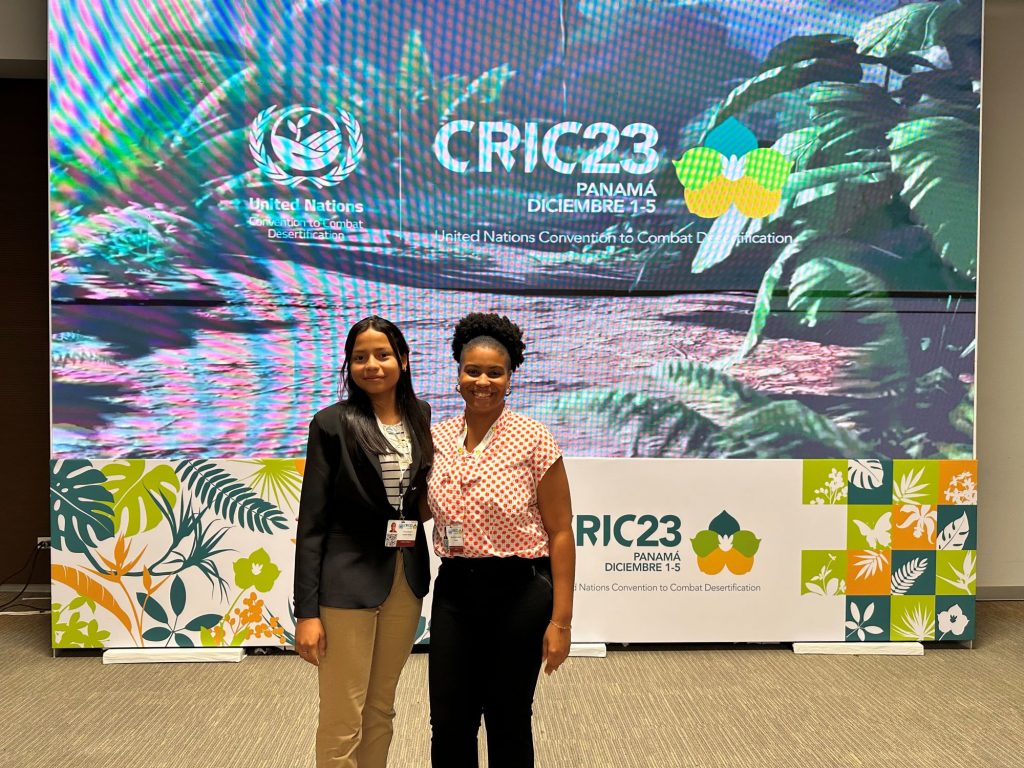
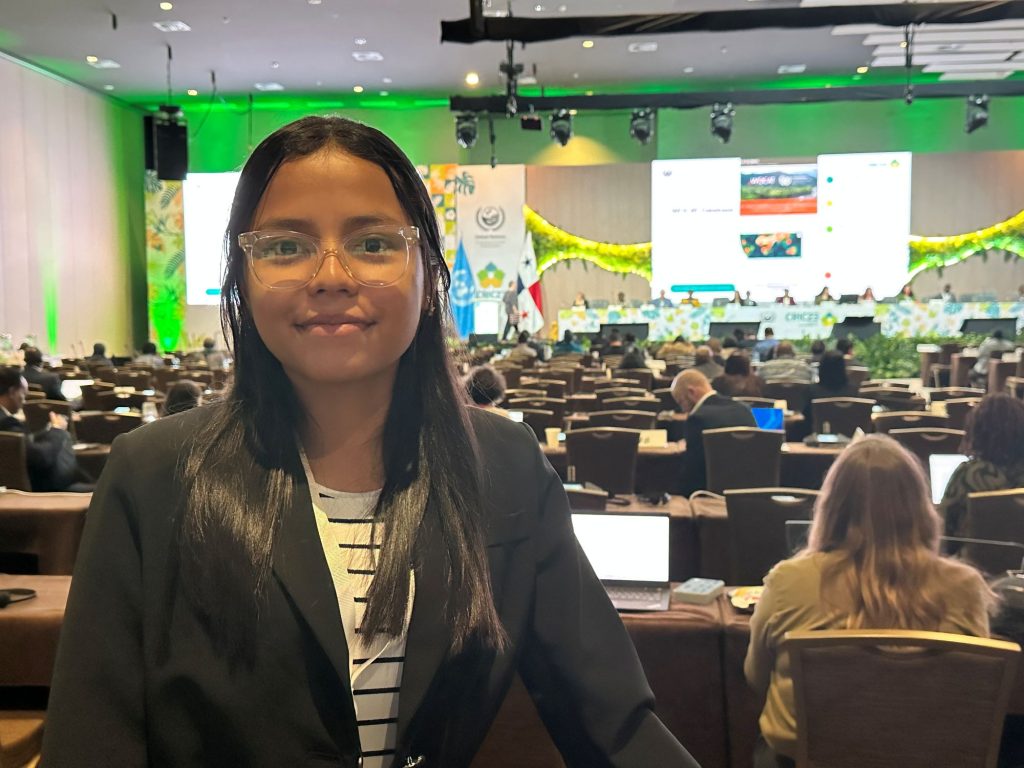
In December 2025, representatives of the ChildFund Alliance, consisting of staff from members, Educo and ChildFund International joined delegates from 196 countries and the European Union at the twenty-third session of the Committee for the Review of the Implementation of the Convention (CRIC23) of the United Nations Convention to Combat Desertification (UNCCD), held in Panama City.
As the only legally binding global treaty addressing desertification, land degradation and drought, the UNCCD plays a critical role in shaping how countries respond to some of the most pressing environmental challenges of our time.
CRIC23 marked a pivotal moment, as Parties assessed current progress and began shaping the pathway toward COP17 in Mongolia. The decisions taken now will help determine whether land restoration and drought resilience efforts truly safeguard the rights and futures of the next generation.
Environmental impacts on children and young people
Healthy land underpins almost every aspect of children’s wellbeing. It supports food security, safe livelihoods, education, biodiversity and climate stability. Yet land degradation and drought are accelerating at alarming rates, eroding these foundations and placing millions of children and young people at risk.
Desertification is not only an environmental phenomenon; it is a powerful driver of inequality that disproportionately affects children.
When land degrades, families lose their livelihoods, food insecurity increases, and poverty deepens. In these contexts, children and young people are often forced to leave school to work, migrate, or walk ever-longer distances in search of water. These are not abstract risks. They shape children’ and young people’s daily realities and their long-term opportunities, often in ways that cannot be easily reversed.

Children and young people must be part of the solution
For ChildFund Alliance, CRIC23 reinforced a crucial truth: action on land and drought must be grounded in children’s and young people’s rights. Their inclusion in decision-making is not optional or symbolic. It is a requirement embedded in global human rights standards, including the UN Convention on the Rights of the Child.
Aligning UNCCD planning, implementation and accountability with children’s rights ensures that environmental action delivers where it matters most—at community level, and in the lives of children and young people who will inherit the consequences of today’s decisions.
Across its 66 member countries, the ChildFund Alliance reaches more than 36 million children and families, many of whom live on the frontlines of land degradation and climate stress. Through our work, one message comes through clearly and consistently: children and young people want to be part of the solution. They are calling for land restoration that protects their futures, for climate action that is fair across generations, and for meaningful opportunities to influence the policies that shape their lives.
Participation leads to policy impact
Educo’s participation at CRIC23 reflected its long-term commitment to child and adolescent participation, leadership development and ecological transition. Years of sustained programmatic investment have enabled children and young people to engage confidently in global policy spaces—demonstrating how participation, when done well, can translate into real advocacy impact and political presence. CRIC23 served as a reminder that listening to children and adolescents is not an act of goodwill, but an obligation if we want lasting and equitable outcomes.
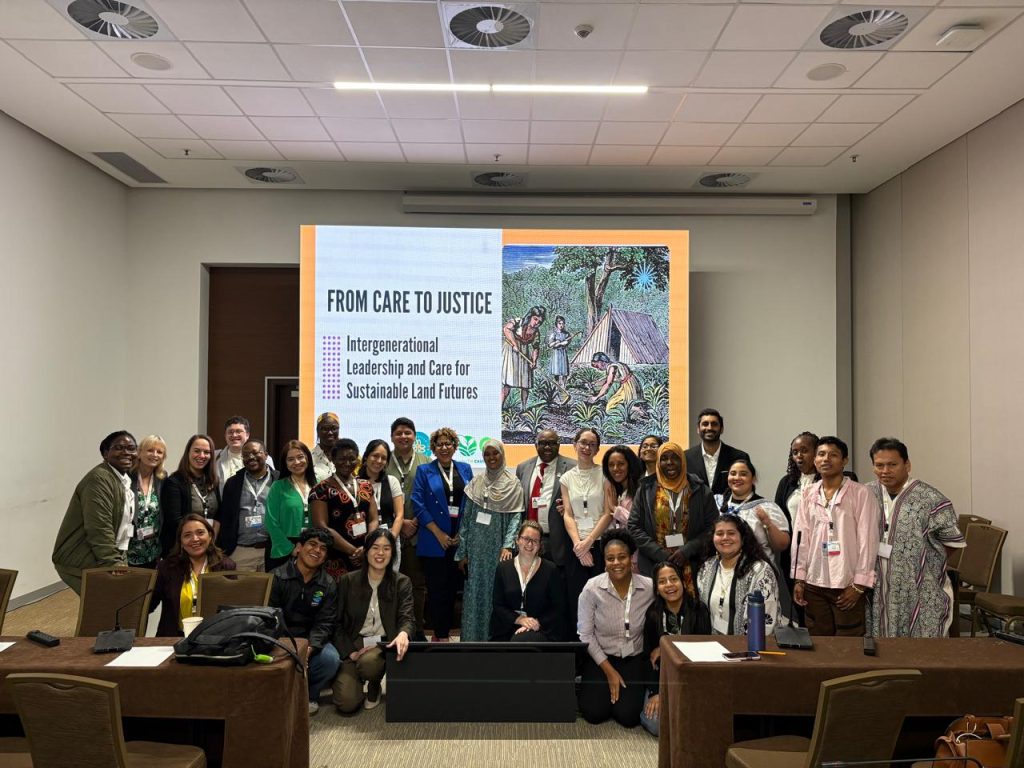
For ChildFund International, CRIC23 also highlighted the transformative power of meaningful youth participation. During a dedicated side event, the focus on desertification as both an environmental and a children’s rights issue resonated strongly.
Young people involved in ChildFund-supported programmes bring lived experience, insight and solutions that are essential for shaping effective policies. When they are prepared, accompanied and genuinely heard, participation becomes transformative rather than decorative.
Setting future directions
CRIC23 further offered valuable opportunities to build alliances with governments, civil society actors and donors who share a commitment to climate justice and children’s rights. These partnerships are critical to strengthening impact and scaling solutions that address both environmental degradation and its soci-economic social and health consequences for children.
As preparations continue toward COP17, CRIC23 has played an important role in setting the direction of UNCCD action. By embedding child-responsive and community-centred approaches now, Parties can ensure that decisions adopted in Mongolia lead to stronger, fairer outcomes—particularly for those who rely most directly on healthy land for survival and opportunity.
The challenge ahead is clear. Desertification, land degradation and drought will continue to shape children’s lives unless decisive, rights-based action is taken. The responsibility lies with today’s leaders to ensure that children and young people are not only protected from harm, but recognised as active agents in building sustainable, resilient futures.
Read the ChildFund Alliance call to action: Our children, our land, our shared responsibility