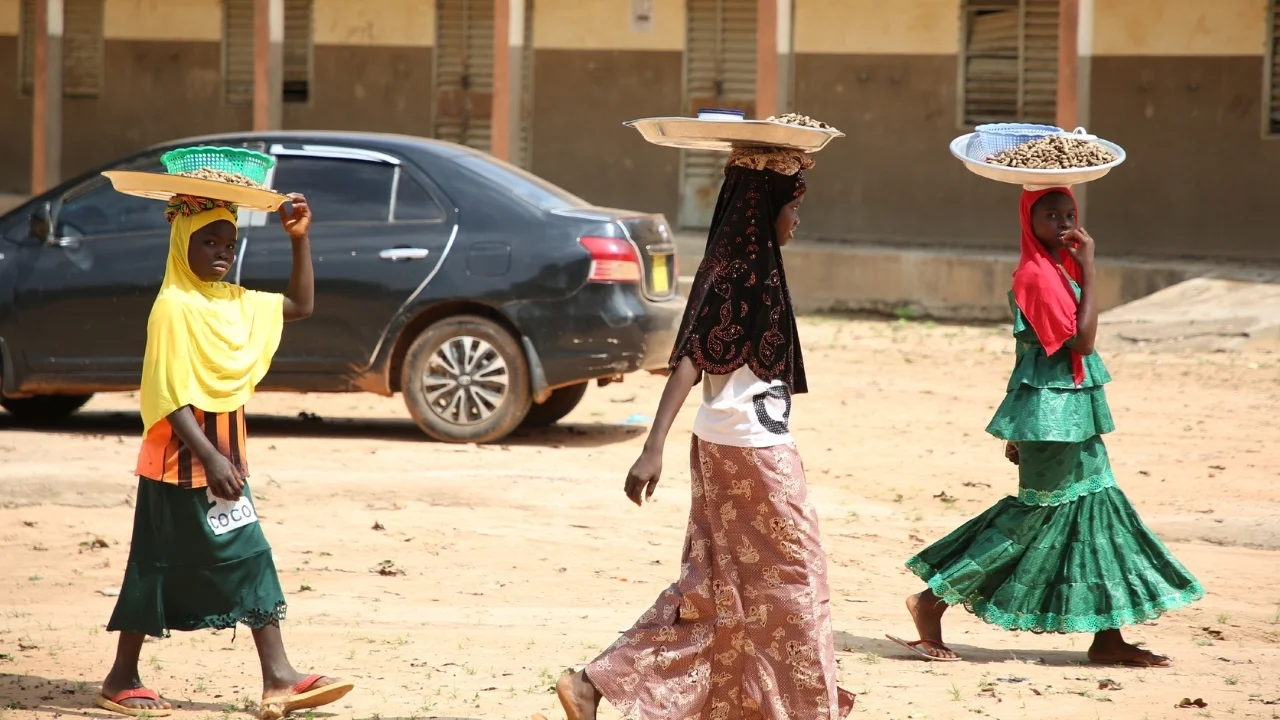
In Burkina Faso, insecurity and violence over the past few years have forced thousands of families from their homes. Schools have closed, livelihoods have been disrupted and many children have been forced to put their education on hold.
In the community of Léo, the displaced population grew to more than 10,500 people, nearly 90 percent of whom were women and children. For many children, displacement has made it increasingly difficult to stay in school.
In humanitarian emergencies like this, displacement, poverty and limited access to education can quickly become part of everyday life. But with the right support, communities can begin to recover and children can return to learning.
Finding hope through education
“Before, we could not move safely, and my school was closed,” says Faiza, a student in Burkina Faso’s Centre-West region. “The project has brought me joy and happiness and also gave me a bicycle to help me get around more easily.”
Faiza’s words capture both the challenges children have faced and the signs of hope emerging as communities rebuild after years of crisis.
Communities like Léo are leading their own recovery with support from Children Believe, local partners and donors. The Integrated Protection and Education Services Strengthening Project, known as PROSIPE from its French acronym, launched in late 2023 and is supporting children and families in one of the country’s most challenging contexts.
The project focuses on strengthening essential services and community resilience, while helping to ensure human rights are respected. A key priority is improving access to inclusive, safe and quality education for vulnerable children — particularly girls and children affected by displacement.
When crisis disrupts learning
Displacement places enormous pressure on families and the communities receiving them. Families may lose their homes and livelihoods, while schools, water systems and health services must support rapidly growing populations with already limited resources.
Classrooms can become overcrowded, while insecurity can make travelling to school dangerous.
Due to the displacement emergency, school enrolment in the region dropped to 67 percent, compared with the national average of 74 percent. Many families could no longer afford school fees, uniforms or supplies. Some children experienced hunger, while others dropped out of school altogether.
These challenges highlight both the scale of the crisis and the importance of helping communities build resilience while keeping children connected to education.
Education and protection go hand in hand
PROSIPE is working in 13 schools across the region where Léo is located. It addresses both immediate and longer-term needs through an approach that brings together education, mental health, child protection and community resilience.
Children Believe has established a child-friendly space in a school and developed 12 mobile child-friendly spaces across the region, providing safe environments where children can learn, play and recover emotionally.
These spaces offer more than physical safety. They also provide psychosocial support to help children process difficult experiences and rebuild their confidence.
“Capacity building for educating stakeholders on child protection in emergencies has helped improve the protection of vulnerable students,” says the project team. “The implementation of preparedness and response plans has strengthened school safety, and students are now more aware of security measures and the risks posed by landmines.”
Helping children stay in school
While significant challenges remain, there are clear signs of progress.
The project has provided mobility tricycles to five children with disabilities, helping them continue their education. Fifteen vulnerable girls have received scholarships, helping to ensure financial hardship does not prevent them from attending school.
The project’s preparedness and resilience training has reached 4,000 students and 600 education staff, strengthening their ability to respond to risks and emergencies.
Bridge classes and open community learning spaces are also helping children continue their education where formal schools remain closed, while radio programs reach children living in areas where attending school is still unsafe.
Rebuilding confidence and resilience
The impact of these efforts can be seen in growing optimism within the community.
As teacher Arouna Koanda explains: “Obviously, since the PROSIPE project has been supporting us, I am thinking of a better future, especially since one of the key principles is that education is the best lever to transform lives, and it intervenes in vulnerable communities where needs remain immense.”
His words reflect a central principle of the project: education is not only about learning. In a humanitarian crisis, it can also provide stability, protection and a pathway towards a more hopeful future.
Local government authorities have also played an important role, working alongside communities and partners to ensure national priorities are reflected in planning and implementation.
Protecting every child’s right to learn
PROSIPE will run until September 2027, supporting children to access formal and non-formal education, learn in safe and inclusive environments, and build resilience in the face of ongoing insecurity.
Children Believe’s approach places children’s rights to education and protection at the centre of community recovery.
Step by step, and with the support of communities, partners and donors, families in Bankui and Nando are rebuilding opportunities for children to learn, feel safe and look towards the future with greater hope.