In Papua New Guinea (PNG), the realities of pregnancy and childbirth for many women are vastly different from those in higher-income countries.
While maternal mortality has reduced from 470 per 100,000 live births in 1990 to 171 per 100,000 live births in 2019, PNG’s maternal and newborn mortality rate remains one of the highest in the Western Pacific region. Only about 45% of women gave birth at health facilities in 2023 and only 5% of health centers are equipped to provide emergency obstetric care 24/7. This means many women and newborns are going without the care they need.
This stark reality is primarily driven by limited access to healthcare. With much of the population residing in remote and rural areas, reaching health facilities can be a monumental and difficult task. Even for those who can, clinics often suffer from a severe lack of essential infrastructure like running water and electricity and are chronically short on vital medical supplies, equipment, and crucially, trained healthcare professionals, especially skilled midwives.
We sat down with ChildFund Australia’s Health Advisor, Nusrat Jahan, to learn more about the critical role ChildFund-trained Village Health Assistants (VHAs) play in improving access to essential healthcare services for families in hard-to-reach areas in PNG.
What is a Village Health Assistant?
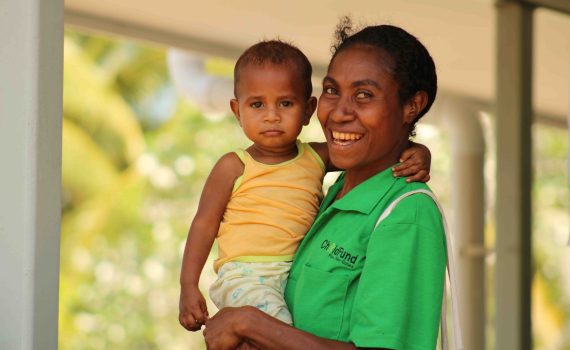
A Village Health Assistant (VHA) is a trained community member who provides basic health services, delivers community health education and facilitates referrals to nearby health facilities. ChildFund, in partnership with local health authorities, mobilizes and trains community members to serve as VHAs.
With strong social and cultural ties, they serve as trusted intermediaries between their communities and the formal health system, playing a transformative role in extending healthcare access and ensuring essential health services reach remote areas.
What type of healthcare support do they provide?
VHAs play a vital role in connecting remote communities to essential healthcare through mobile outreach clinics – a one-stop access point for basic health services. These clinics provide pregnancy care, support for new mothers, routine childhood immunizations and growth monitoring, family planning and tuberculosis screening.
ChildFund equips VHAs to deliver healthcare directly to communities that would otherwise go without. Their duties in these outreach clinics include essential tasks such as bringing communities together in one place, record keeping, making referrals and promoting health awareness while people receive various health services.
A major part of their role is providing health education – engaging women in practical conversations about breastfeeding, nutrition and child health, often within culturally safe spaces where women can access accurate information and family planning advice. VHAs also regularly refer pregnant women to health facilities for safe deliveries, identify children needing vaccinations, and assist with births when health facilities are unreachable.
On a recent visit to an outreach clinic in rural PNG, I saw this work in action. I met Alice Lagani, one of the VHAs who identified early symptoms of tuberculosis in a pregnant woman in her community and referred her to the health facility. Thanks to Alice’s referral, she was screened, diagnosed and quickly began treatment – a powerful example of the life-changing impact just one volunteer can have.
From safe births to early detection of illness, VHAs are improving health outcomes in some of PNG’s most remote and underserved communities.
Josephine’s Story
Josephine has been a Village Health Assistant in her community for over 12 years. She’s a respected leader. She is there for her community, day and night. Josephone regularly runs groups for pregnant mums in the village, teaching them the early signs of labor so they can alert her in time.
The closest health center to Josephine’s village closed over a year ago, leaving her community without easy access to essential healthcare.

Recently, she assisted a young woman called Wendy, who went into labor in the middle of the night. Josephine immediately sprang into action, calling for an ambulance, helping Wendy cross the river in a dinghy and waiting with her until help arrived. Without Josephine, Wendy might not have had the chance deliver her baby safely at a health center.
Josephine explained: “Wendy’s labor pains began around 5am in the morning so there was no transport for us to bring her to the health center in Kwikila. I was struggling and called the ambulance. Unfortunately the dinghy to get us across the river was gone. I got on the canoe to bring Wendy over to the ambulance.”
Health services in PNG are overstretched, under-resourced and simply not meeting the needs of the most vulnerable people. For women and children living in remote areas, where the nearest health center is often a long and arduous journey away, community health volunteers like Josephine are a lifeline.