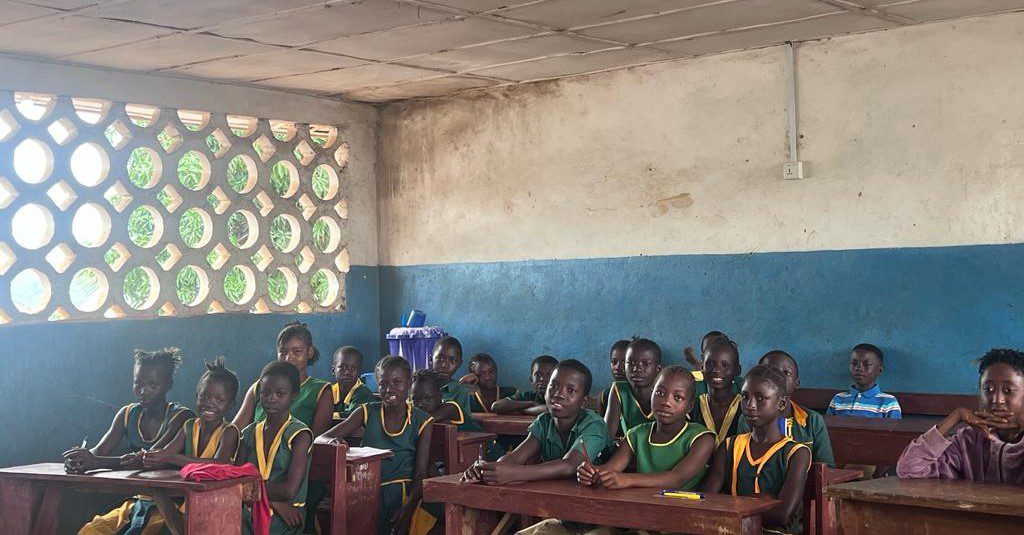
The establishment of community savings groups in Sierra Leone is contributing to greater financial security among farming families, allowing parents to budget for the ongoing costs of their children’s education and avoid becoming prey to money lenders. These cooperative forms of financial management are helping to keep children in school and out of work.
While attending school is technically free for children in rural Kailahun District, Sierra Leone, the cost of simple school supplies such as textbooks, backpacks, and school uniforms can present an enormous barrier to education.
For children like John, aged 12, and his sister Fatmata, aged 8, their education depends on three things:
- the success of the cocoa harvest,
- their parents’ ability and willingness to prioritize school, and,
- access to a quality learning environment.
A commitment to education
John and Fatmata’s parents, Nancy and Ibrahim, never had a chance to go to school themselves. They never learned how to read or write. They grew up working on cocoa farms as children and have remained farmers ever since.
Their parent’s experience could mean that John and Fatmata are at greater risk of dropping out of school to work. Their parents, however, are determined for their children to get an education.
“Even though we are not literate, we had the urge and dream for our children to complete school and be better placed in society,” says Ibrahim. “The fact that we are farmers doesn’t mean that our children should also take after us. We did not want that for our children. We want the best for them.”
Finding money for schooling
It hasn’t always been easy. For years, money lenders have reigned supreme in communities in this part of Sierra Leone – the only financial institutions known to many rural subsistence farmers. They charge very high interest rates that farmers cannot pay after sales of their produce.
If they cannot pay the excess interest rates, farmers are forced to forfeit their produce. The interest rates are almost never commensurate with their yield, putting parents under intense pressure to allow children to drop out of school to help them meet their loan targets.
Ibrahim and Nancy had been down that road of having to pay huge sums in interest. “This was really painful, but we had no choice,” says Nancy. “It’s like we were farming for the money lenders’ benefit. There was a time where we found it very hard to buy food, and our children stopped going to school for a while because we couldn’t afford to buy them what they need for school. This made me sick.”

How savings groups are making a difference
In 2021, ChildFund International began implementing the Community Approach to Combating Child Labor Project, funded by Tradin Organic. The project had three goals:
- to improve the livelihoods and economic capabilities of 6,000 cocoa and coffee farming families and eliminate child labor among those aged 6 to 17 years,
- to strengthen formal and informal community-based child protection systems, and
- to improve reporting, response and referral mechanisms on child labor.
Savings groups function as an alternative to families borrowing from high-interest lenders. This approach helps members save money together, lending the savings to each other at reasonable interest rates payable at each family’s own pace.
Members share the profit of their savings, which is why savings groups are based on trust, leveraging social connections to create the motivation for saving.
Nancy and Ibrahim began saving the little money they were getting from the sales of their produce in the special group savings box. When they needed money, they could borrow from the savings group at a reasonable interest rate.
Through the project, 57 savings groups – including Nancy’s – were set up in Kono, Kailahun and Kenema districts.
Building financial security
Today, Nancy and Ibrahim’s group alone has saved up NLE 14,900 (USD 700). This has helped bring about a new era for the family – one in which the start of a new school year no longer brings stress about money.
“Since our parents joined that group, things have not been the same,” John says. “We have enough for school and home. All of my school materials, such as books, pens, shoes and uniforms, were brand new.”
Food, too, is less of a struggle. “We have never gone to school hungry since that [savings] box came to our village. The last time our father took money from the box, he bought a bag of rice for the home,’’ says Fatmata. Rice is the staple food in Sierra Leone, but many families cannot afford to buy a full bag of rice at NLE 700 (USD 35). “I feel sad sometimes for friends whose parents cannot afford to give them proper lunch. I share my food with most of my friends during lunch hours.”
“The savings box has actually made things easy for us,” Nancy says. “Going to the bank to get a loan was almost impossible. Even when you were finally eligible for the loan, you would have to go through a lot of processes and filing papers. For people like us, who are not literate, it’s a challenge. With the savings box, there is no protocol. We just go to the box holder and request the loan as per our entitlement, and it’s done in less than 10 minutes.
“There is hope in that box,” she says.
Breaking the cycle of poverty
Today, John has just transitioned to junior secondary school 1 (JSS1), and Fatmata is in class 3. They do house chores and study, and they don’t have to spend their days on the farm carrying the physical and emotional burden of the cocoa harvest.
They are both looking forward to a bright future. “I would like to be president of Sierra Leone one day,’’ says John confidently.
Meanwhile, Fatmata, who had just recovered from malaria at the time she was interviewed for this story, says, “I would like to be a medical doctor so I can help treat those who are sick.’’