
Play is often a feature of childhood, but in communities where children are tasked with water collection, farming work, and other activities to ensure the basic needs of families are met, there often isn’t time available for play.
In rural Uganda, making sure everyone has food to eat takes priority. The financial obstacles are significant, but there is also a lack of knowledge about how play benefits children’s development and strengthens the relationship between children and parents.
Cognitive, social and physical development
Play and games are crucial for children’s development on several different levels. Not only do they provide enjoyment, but they can have a significant impact on children’s physical, cognitive and social abilities.
Through play, children can explore their surroundings and develop their physical skills. They learn to crawl, walk, run, jump and coordinate their movements.
Games also develop children’s cognitive development by stimulating their imagination and creativity. Role playing and pretend play give young people the ability to think abstractly and solve problems.
Play and games also teach children to cooperate, share, wait their turn and respect the opinions of others. They develop important social skills such as empathy and conflict resolution. Group play is also an opportunity to create and maintain friendships and family relationships.
Creating opportunities for play
ChildFund International, with the support of Barnfonden, is implementing the ‘Come and play with me’ project in Gulu district, Uganda. This focuses on helping parents and caregivers understand how the importance of play.
With the support of the Lego Foundation, the project aims to encourage caregivers to spend more time with their children in playful activities, and shows how to create toys from what is available at home. Through the project, parents also have the opportunity build stronger relationships with their children based on joy, playfulness and community.
Strengthening family bonds
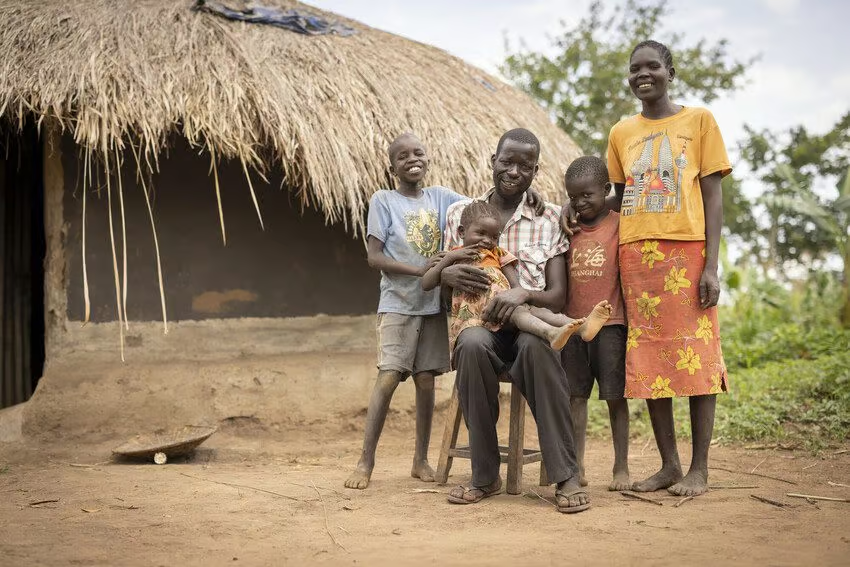
Jackyline, her husband Bernard and their three children Steward, 10, Marvin, 7, and Racheal, 3, have been involved in the project since 2022.
Jackyline and Bernard, who support their family with farming, had previously prevented the children from playing because they considered it more important for them to help with farm work or household chores.
Nowadays, the parents create time for the children to play on their own and with the family. Time that was previously devoted to household chores has instead become time for leisure and play. Jackyline and Bernard sometimes play with the children themselves when they have time to spare after the farm work. They have noticed a positive change for the whole family since the project started.
Jackyline explains: “I have learned how important it is to take the time to play with my children. Before, the kids used to not play here at home because my husband and I didn’t see the necessity of it and stopped them, but now we encourage them instead.
“The children are much more present and we spend more time together as a family.”
Using tablets with educational games
It is not only games with physical activities that are promoted. Reading tablets with educational games and activities were introduced to families during the COVID-19 pandemic and have continued to be a useful resource for learning and engagement at home.
The reading tablet contains riddles and puzzles that help children with language and mathematics. In addition, there are educational materials on nutrition, sanitation and hygiene that everyone can take advantage of.
“Ever since we got access to the reading tablet, the children have started to perform better in school, “says Jackyline.
A positive change in Gulu
Since the project began, many of the families involved feel that they have gained an increased understanding of children’s need for play and a closer relationship with each other.
In addition, parents and caregivers see that the children are developing abilities that they will later make great use of in adulthood. The impact has been positive for both young people and caregivers alike.